Do Kids Really Need Sealants on Baby Tweth
Let's talk about your child and dental sealants.
Although an increasing number of dental professionals stress the need for dental sealants for kids, many parents even so aren't certain what they are or why their kid needs them. Like any good parent, you desire to do your homework and understand what dental sealants are earlier you sign off on them. What are they? How are they used? What are dental sealants fabricated of? And what kind of process will your kid need to put them in place?
We've got you covered!
Our guide to sealants is designed to help you brand an informed decision regarding your child's dental wellness, answer your questions and put your mind at ease.
What Are Dental Sealants?
Accept a moment to utilize your natural language to touch the molars in the dorsum of your oral fissure. Notice the crevices and pits along them? These are called "grooves," and they're highly susceptible to germs and bacteria that build up when food particles — especially sugars — become trapped inside of them. Although regular brushing goes a long way, even the about dedicated of brushers tin can struggle to make clean those grooves properly.
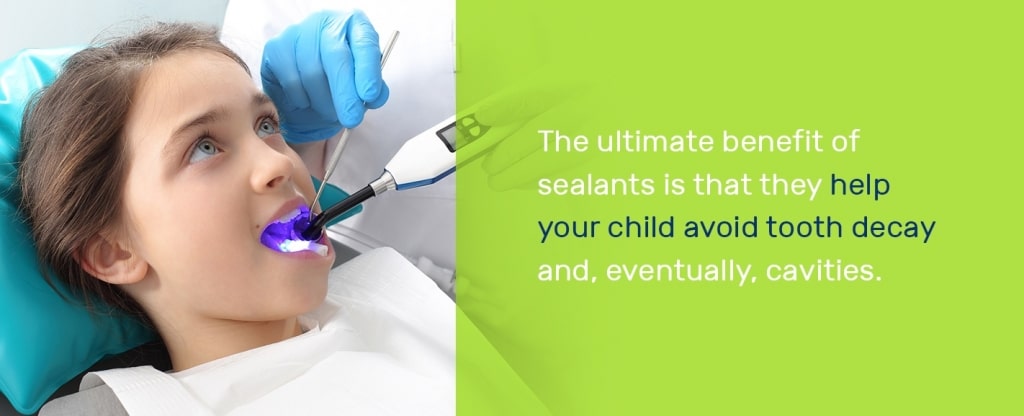
Dental sealants are a sparse blanket placed over the biting surface of a child'south molars to protect them from the decay. A dental sealant is a thin white or articulate resin liquid applied to the surface of a kid's molars with a small castor. The liquid sealant is bonded to the tooth and dries by using a blueish LED lite, leaving a hard layer of protection. Co-ordinate to the American Dental Clan (ADA), that protective layer reduces your child's risk of cavities past 80%. It's non-invasive and doesn't require the apply of numbing agents or anesthesia because information technology isn't painful. There is also no drilling required, which is also a huge perk!
As a parent, your main goal is to protect your child. So you're probably wondering if dental sealants are safe.
Yes, dental sealants are safe and pose minimal risk to your child during the procedure or while they are on their teeth. Because sealants are just bonded to the tooth, nix goes inside the tooth, equally a filling would. That's why sealants are a great not-invasive fashion to help protect your child'south teeth from cavities.
Many parents want to know what sealants are made of. Sealants are made of a medical course resin, and are like to composite, or white filling material for when patients have cavities filled. The big difference about sealant material is it's runny nature. When applied to the tooth with a small brush, it will easily flow into the micro grooves and crevices of your child'southward teeth. Imagine white finger nail smooth, but for teeth! Historically, there has besides been some concern nigh BPA in sealants, only most mod sealant materials are BPA-complimentary!
Why Sealants Work
Dental sealants are designed to cover chewing surfaces of the back teeth and aid keep out germs, food, and plaque. They substantially form a shield over the grooves in molars and make it easier to keep back teeth clean and protect them from minuscule food particles and leaner that might otherwise hide in those grooves. By "sealing" out bacteria, nutrient, and other cavities-causing substances, sealants help protect teeth from getting cavities.
What Are the Benefits of Sealants?
Many parents want to know about dental sealants' pros and cons. The ultimate do good of sealants is that they help your child avert tooth disuse and, eventually, cavities. Sealants are a preventive process, equally they help prevent and protect teeth from cavities. In a study that compared schoolhouse-aged children with and without sealants, children without sealants were 3 times more probable to accept cavities than their peers who had dental sealants. In the same report, the U.Southward. Centers for Disease Command also noted that dental sealants have the potential to relieve $300 million in dental costs effectually the state.
Oral hygiene likewise has a direct touch on on a child's performance in school. Children who have molar disuse tend to have bug eating and sleeping, which interferes with attendance and performance in school. Although it's a stretch to say that dental sealants volition assist your child do better in school, they practise have a very direct impact on your child's wellness and mental clarity. In other words, dental sealants are a simple mode to set your child up for success and forbid pocket-sized problems from becoming big ones.
When information technology comes to the downsides of dental sealants, there really aren't whatever. Occasionally, they can scrap or wear away, requiring repair or replacement, only this isn't very mutual and isn't a big deal when it happens. Some other downside about sealants is they don't last forever. Normal wear and tear will crusade sealants to thin out over time. However when washed properly, sealants can terminal a minimum of iii-5 years, even up to 10!
Fluoride vs. Dental Sealants
Many parents mistakenly believe that flouride treatments during dental hygiene and check-up visits are just every bit constructive as dental sealants. This isn't truthful. Although flouride treatments are an essential part of protecting your child's teeth, they are most constructive when used in tandem with dental sealants.
In an ADA report comparing children who only received flouride compared with children who received flouride treatments and dental sealants, the children who were given both were 73% less likely to nowadays with cavities later.
Fluoride helps to remineralize and strengthen all surfaces of enamel. Dental sealants, however, alter the anatomy of the teeth, making grooves less deep, and therefore, less probable to retain plaque and nutrient particles.
How Do Dentists Apply Sealants?
Applying dental sealants is a fast and painless procedure. When you and your kid arrive at the dentist for their sealant appointment, they'll be placed in a chair in a regular exam room. In that location is no drilling and no numbing required with dental sealants. Can can expect a relatively fast and easy process:
- Make clean the teeth being sealed with a polishing brush and pumice (gritty toothpaste).
- Dry out the teeth and isolate them from any saliva from the tongue and cheeks using a small cotton roll or triangular intra-oral cheek shield called a "dry bending."
- Apply an etching solution to the surface of the tooth being sealed to disinfect and prep the tooth for better sealant adherence.
- Rinse off the etching solution and dry teeth again.
- Pigment on a thin bonding layer, followed by the sealant, directly onto the surface of the molar, roofing the enamel.
- Use an LED blue light to assistance the "cure" the sealant. This allows for faster application, as it hardens and bonds the sealant to the tooth surface.
After the sealant is hardened, your kid's appointment will be complete. Each tooth being sealed takes about just one minute! There are no restrictions following sealants, patients tin can swallow and drink correct abroad, and tin return to schoolhouse immediately later on.
How Long Do Dental Sealants Last?
Dental sealants for a kid are designed to protect your child's teeth for a minimum of 3-v years, even up to 10 years, if they're well maintained. During your child's regular dental checkups, the dentist will check the sealants to ensure they are still in place and haven't cracked or worn away. If they are damaged, then they tin be quickly and easily repaired.
Sealants tend to "fail" or fall off hands if the tooth is non impeccably clean or dry as the sealant is being applied. For wiggly patients, or patients with an active tongue or sensitive gag reflex, the application procedure tin be more than challenging, and your dentist may delay application by 6-12 months to permit for better cooperation if necessary.
Does Insurance Cover Sealants?
Many insurance plans do cover dental sealants. Nigh insurance companies consider sealants to exist a "preventive" procedure, which means that they are normally covered at the highest level, normally 80-100% of the total cost. Check with your insurance provider to determine the scope of their coverage, as some insurance companies put historic period limits on sealants.
Who Should Get Sealants?
Dental sealants are an of import preventative measure designed to give your child'south smile every possible advantage. Many dentists recommend children get sealants on their teeth as soon as their permanent molars arrive to prevent decay from the beginning. Applying dental sealants has become the standard of care among well-nigh pediatric dentists.
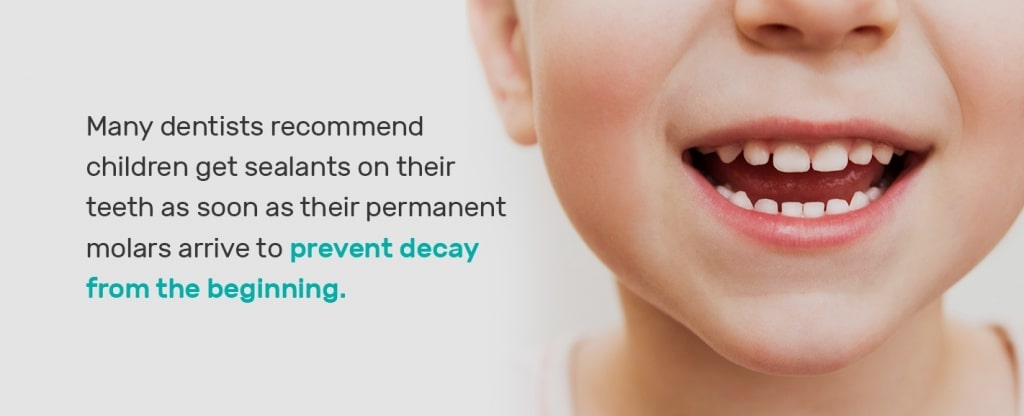
The beginning set of permanent molars — also known as "six-Year-Old Molars" — typically go far between ages 5 and 7. When your kid's next set up of molars — "12-Yr-Old Molars" — arrive subsequently, your dentist can use additional dental sealants. These second molars unremarkably come in between 11 and 14 years of age.
Although non as common, some dentists will recommend dental sealants for immature children whose "baby" molars have significant grooves or pits in them. Although these teeth volition eventually fall out between ages ten-12, it'due south still essential to protect your child's oral health early and foreclose problems that may plague them later on.
Pediatric Dental Sealants
At Sprout Pediatric Dentistry & Orthodontics, we're privileged to walk abreast children and their parents throughout their early years. Our goal is to teach proper oral hygiene habits and encourage the awarding of important preventative measures — such as pediatric dental sealants — that will protect a child's smile for years to come. Merely we don't stop at cleanings and dental sealants. Sprout Pediatric Dentistry & Orthodontics is happy to combine pediatric dentistry with orthodontics, providing a comprehensive oral wellness practice that serves children at all ages and stages.
Schedule an appointment today!

Dr. Dana grew up in Portland, and went to Temple Academy in Philadelphia, PA for dental school. She then moved to Anchorage, AK for her residency in Pediatric Dentistry. Dr. Dana takes a holistic arroyo to pediatric dentistry & is able to use her ain parenting experience to understand and empathise each family's unique dynamic.
Source: https://www.sproutpediatricdentistry.com/blog/pediatric-dentistry/dental-sealants-for-kids-guide/

Post a Comment for "Do Kids Really Need Sealants on Baby Tweth"